Skip to content
Trail&Pass
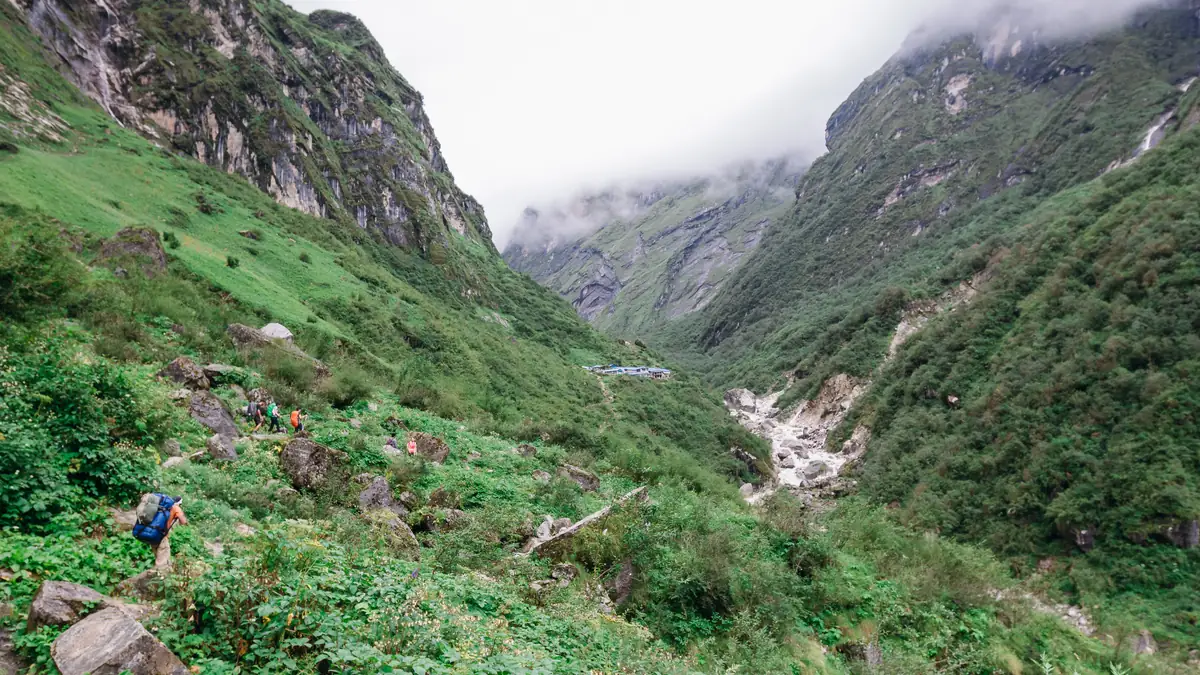
Trekkers on the way through the green Modi Khola gorge towards Deurali

Annapurna Base Camp · Preparation

Annapurna Base Camp preparation: stairs instead of rubble, altitude in moderation, and a sleeping bag from Pokhara

The trek into the Sanctuary is easier than the one to Everest and harder than the operators write: there are no glaciers and no nights above 4,400 m, but stone stairs with thousands of steps, seven-hour days, a gorge with an avalanche slope and an amphitheatre where it freezes at night. Here is what the body needs, what the altitude does, what gear the packages bring – with seventeen of nineteen almost none – and what can be rented in Pokhara.

Editorially checked on 25 September 2026Prices as of 23 September 2026Photo: Bijay Chaurasia, CC BY-SA 4.0
In short
  • Fitness5–8 hours a day, 600–1,000 m of ascent and often as much descent; Ulleri 3,000 steps, Chhomrong–Sinuwa 400 m down and 400 up
  • AltitudeOnly one or two nights above 3,500 m (MBC 3,700, ABC 4,130); headache common, serious altitude sickness rare – the five-day treks carry the highest risk
  • AvalanchesDeurali–MBC in winter and spring; guides go early and not in fresh snow; fatal avalanche in January 2020
  • Gear from the operatorSleeping bag and down jacket only with Outfitter and Base Camp Adventure; poles with CAN; duffel with five – the rest comes from Pokhara
  • InsuranceTrekking to 4,500 m with helicopter rescue; named as mandatory by Outfitter, Himalayan Recreation, Nepal High

The path: stairs, stairs, and a gorge

The paths in the Annapurna region are paved village paths, and the villages lie on hillsides: that means stairs. To Ulleri it is over 3,000 steps in a row, from Chhomrong down to the Chhomrong Khola and up to Sinuwa another 400 m each way, and the way back from base camp to Bamboo has 1,800 m of descent in one day. If you have knee problems you need poles – CAN provides them, nobody else does. The gorge between Sinuwa and Deurali is the most beautiful part and the wettest: bamboo, moss, waterfalls, leeches in the monsoon. From Deurali it becomes open, stony and cold.

Daily stages are between five and seven hours; Ghandruk–Sinuwa on the seven-day treks is seven to eight. If you regularly walk six hours with 800 m of ascent at home and can do it again the next day, you have the fitness. The trek does not need strength, it needs knees.

Altitude: 4,130 m in two to three days from Chhomrong

From Chhomrong at 2,170 m to base camp at 4,130, most programmes take three days with nights in Bamboo or Dovan (2,300 to 2,600), Deurali (3,200) and then up top. That is a sensible pace: never more than 1,000 m of sleeping altitude gained per day, and only one night above 3,500. Headache and poor sleep in the Sanctuary are still normal; if you take them seriously, sleep at Machapuchare Base Camp at 3,700 and walk up in the morning. The five- and seven-day treks cut: Holiday Planner sleeps in Sinuwa, Deurali, ABC – from 2,340 to 4,130 in two days. That works for fit people who have never had altitude sickness; if you do not know, take a day more. No product names an oximeter except Base Camp Adventure; none mentions Diamox.

Altitude becomes dangerous when headache does not improve after a night or confusion, staggering, breathlessness at rest are added. Then it is down – to Deurali, to Dovan, two hours are often enough. The guides know this; you have to tell them.
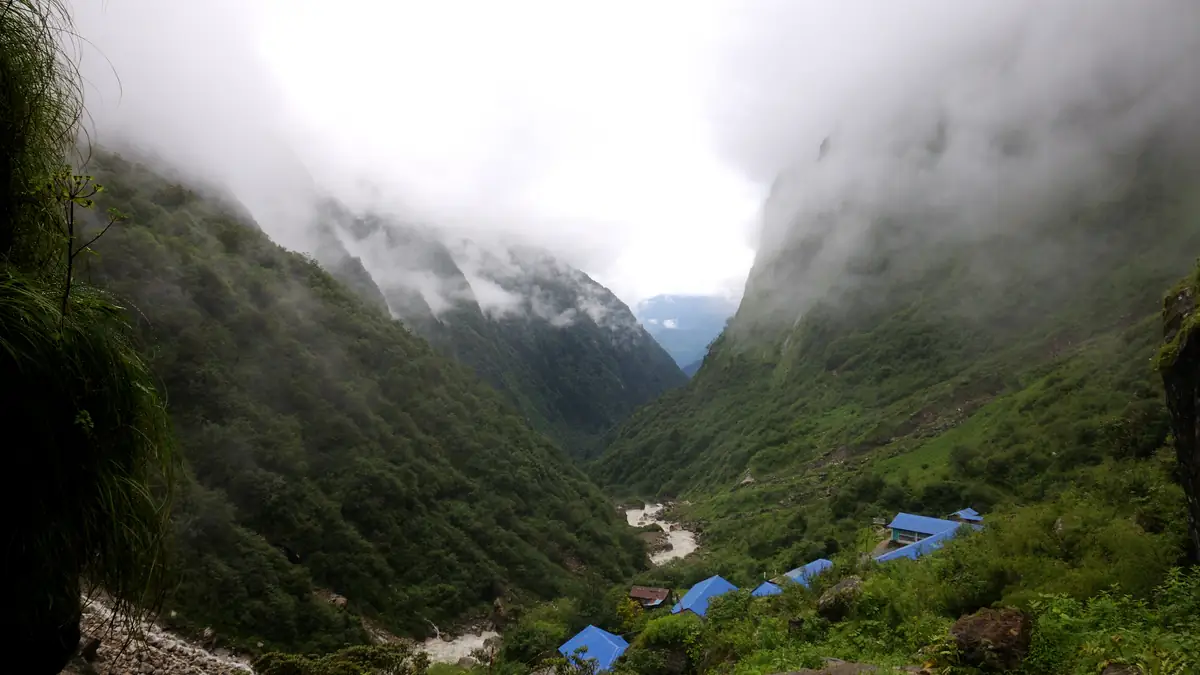
The lodges of Deurali in the cloud-filled Modi Khola valley
Deurali, 3,200 m: the last lodge in the forest, and behind it the slope you cross in the morning before the sun.Photo: Josep M. Gracia, CC BY-SA 4.0

Avalanches, leeches, landslides: the risks by season

Avalanches: between Deurali and Machapuchare Base Camp the path crosses slopes where avalanches come down in winter and spring – in January 2020 trekkers and guides died there. ACAP closes the section at times; the guides walk it early in the morning and not in fresh snow. If you go from December to March, plan a buffer day and listen to the guide, not the schedule. Leeches: from June to September in the forest between Ghandruk and Deurali; salt, long trousers, gaiters. Landslides: in the monsoon on the jeep roads, then you walk from Nayapul. Cold: in the Sanctuary from November to March −5 to −15 °C at night; the lodges heat only the dining room. Insurance: a policy covering trekking to 4,500 m and helicopter rescue – Outfitter, Himalayan Recreation and Nepal High require proof; a helicopter from the Sanctuary costs several thousand dollars.

Packing list: what to bring, what to rent

WhatWhyFrom where
Boots above the ankle, broken instairs, gravel, snow from Deurali in winterbring – never rent
Walking poles1,800 m of descent from base camp, stairsbring or rent (CAN provides them)
Sleeping bag to −10 °Crooms unheated, Sanctuary −5 to −15 °COutfitter/Base Camp Adventure lend; otherwise Pokhara, ≈ USD 1–2/day
Down jacketevenings in the Sanctuary, morning at the viewpointoperator or rental Pokhara
Rain jacket and trousers, ponchoafternoon rain in the forest, monsoonbring
Layers: 2–3 tops, fleece, 2 trousers, thermal underwear25 °C in Ghandruk, −10 °C up topbring
Hat, sun hat, gloves, buffcold up top, sun belowbring
Wool socks 4 pairs, sandalslodge evenings, hot springsbring
2 litres of water, filter or tabletsbottled water USD 1–3/l; Nirvana includes tabletsbring
Headtorch, power bankPoon Hill before sunrise, charging costsbring
Sunglasses, sunscreen, lip balmhigh-altitude sun, snow in the Sanctuarybring
Travel pharmacy: ibuprofen, blister plasters, anti-diarrhoeal, salt against leechesknees, stomach, monsoonbring
Swimwear, small towelhot springs in Jhinu, showersbring
Cash in rupees, passport, passport photos, proof of insuranceno ATM after Chhomrong; permit checkwithdraw in Pokhara

With a porter: duffel up to 15–20 kg plus daypack. Without a porter (Nirvana, Glorious, Himalayan Recreation, CAN, MDA): everything together under 10–12 kg – then rent the sleeping bag, do not buy.

Renting in Pokhara: Lakeside has everything

The Lakeside road in Pokhara is one long gear mile: sleeping bags to minus 15, down jackets, poles, rain ponchos, duffels – rented for around one to two dollars per day and item against a deposit, bought cheaply in local manufacture. Himalayan Recreation says so expressly, Nepal Hiking Team describes the shops in Kathmandu in detail. With the packages from Kathmandu the afternoon in Pokhara before the trek is for this; with those from Pokhara you should arrive a day early. What you do not rent: boots. What you check: zips and seams on the sleeping bag, because in the Sanctuary you feel every gap.

Questions about preparation

Is the trek for beginners?

Yes, if the fitness is enough for seven hiking days and the knees tolerate stairs. It needs no mountain experience; the altitude is moderate if you take three days from Chhomrong. For a first Nepal trip it is the better choice than Everest.

ABC or Everest Base Camp?

ABC: shorter, cheaper, lower, without flight risk, with villages and forest, in an amphitheatre of eight-thousanders. EBC: higher, longer, colder, with the Lukla flight and the name. If you fear altitude or have little time, go to the Sanctuary; if you want both, do ABC first. The comparison of requirements is there.

Can I go with children?

Scenic takes children from nine, the others give no figure. Up to Chhomrong or Poon Hill the trek is very doable for sporty children; the Sanctuary with its altitude and long days makes sense from about twelve. A porter who occasionally carries a child helps.

How heavy is the rucksack?

With a porter: five to seven kilos a day (water, jacket, rain gear, camera, snacks). Without a porter: ten to twelve with sleeping bag – then rent instead of buy, and halve the clothing. The porter takes up to 20 kg for two guests.

Sources and check status

Show 8 sources
  1. www.viator.com/tours/Kathmandu/Annapurna-Base-Camp-Trek/d5109-33122P27 – Ace the Himalaya, 13 days: itinerary with altitudes and hours, inclusions (Viator Partner API) (accessed 25 September 2026)
  2. www.viator.com/tours/Kathmandu/Annapurna-Base-Camp-Trek/d5109-7649P4 – Outfitter Nepal, 11 days: sleeping bag loan, porter USD 20/day, tiers (Viator Partner API) (accessed 25 September 2026)
  3. www.viator.com/tours/Pokhara/5-Days-Annapurna-Base-Camp-Trek/d22291-32 – Holiday Planner, 5 days from Jhinu: kilometres per day, porter, tiers (Viator Partner API) (accessed 25 September 2026)
  4. www.viator.com/tours/Pokhara/Annapurna-Base-Camp-Trek-8-days/d22291-55 – Trekking Planner, 8 days from Pokhara: kilometres per day, German as guide language (Viator Partner API) (accessed 25 September 2026)
  5. www.viator.com/tours/Kathmandu/Annapurna-Base-Camp-Trek-10-Days/d5109- – Himalayan Recreation, 10 days: without lunch, USD 200 for a guide in another language (Viator Partner API) (accessed 25 September 2026)
  6. www.viator.com/tours/Kathmandu/12-Day-Annapurna-Base-Camp-and-Poon-Hil – Scenic Nepal, 12 days with flight: full exclusions list, minimum age 9 (Viator Partner API) (accessed 25 September 2026)
  7. ntb.gov.np/ – Nepal Tourism Board: TIMS, compulsory guide (2023) (accessed 25 September 2026)
  8. ntnc.org.np/project/annapurna-conservation-area-project – National Trust for Nature Conservation: Annapurna Conservation Area Project, entry fee (accessed 25 September 2026)